Your clinic client wants digital radiography. They have a budget, a room, and no clear idea which system fits. You have two products that both “take X-ray images” — and the wrong recommendation costs you the account twice: once when the machine underperforms, and again when they tell the next clinic in town.
This is the comparison we give our own distributors. It is deliberately honest, because a distributor who recommends the cheap option when it is the right option earns the upgrade later.
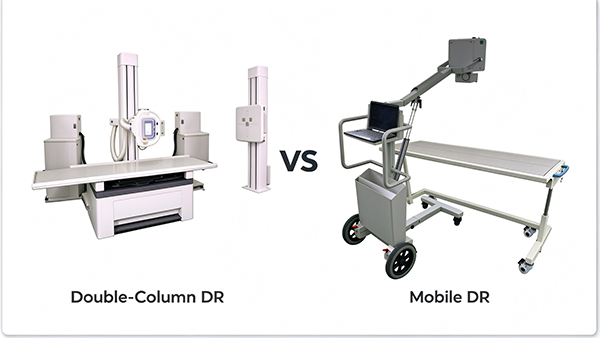
| If the clinic… | Recommend |
| Runs fewer than ~15–20 exams a day, has a small or awkward room, or serves bedridden patients | Mobile DR |
| Runs 20+ exams a day, needs full-body coverage including supine and weight-bearing views | Double-column DR (NK501) |
| Sits in between, or has no shielded room yet | Mobile DR + a vertical bucky stand — the middle path most clients actually need |
Everything below is the reasoning behind those three lines, so you can defend the recommendation in front of the clinic’s owner.
Where mobile DR genuinely wins
Be the first to say this out loud: for a lot of small clinics, mobile DR is the better buy.
1. No shielded room, no civil works. A double-column system needs a radiation-protected room with ceiling height above 2390 mm for the moving column. A clinic renting a converted shopfront often cannot meet that, and the renovation quote can exceed the equipment budget. Mobile DR goes where the patient is — ward, bedside, even a corridor with proper shielding practice.
2. Bedridden and elderly patients. A double-column system assumes the patient can stand at the upright bucky or lie on the table. If most of the clinic’s patients arrive by wheelchair or stretcher, that assumption fails daily. Mobile DR was designed for exactly this.
3. Low volume does not justify fixed geometry. At eight exams a day, the throughput advantage of a fixed system never materialises. What the clinic feels instead is a large machine occupying a room that could be a treatment area.
4. Lower total cost of entry. One unit, no table, no separate bucky stand, no room work. For a new clinic testing whether radiography is worth offering at all, this lowers the risk of the decision.
What mobile DR gives up at 400 mA: thick-body parts and large patients are harder, positioning is more variable because nothing is fixed, and every exam involves moving the machine and re-positioning the tube head by hand.
Where the double-column NK501 pulls ahead
Above roughly 20 exams a day, the economics flip — and the flip is about time per patient, not image quality.
1. Two positions, one room, no patient transfer. NK501 uses two independent columns: one carries the tube, one carries the detector, moving in lateral linkage. Standing and supine imaging happen without moving the machine body — the patient moves less, the workflow moves more. At 25 exams a day, saving two minutes per exam returns almost an hour of staff time.
2. Table-based imaging with real geometry. The floating tabletop travels ±560 mm longitudinally and ±120 mm laterally, with a built-in 40 L/cm, 10:1 grid at 100 cm convergence. Consistent geometry means consistent images — critical for follow-up comparisons and for readers who do not want to guess at angulation.
3. Power headroom for difficult body parts. NK501 runs 40–125 kV at 10–640 mA, with a 50 kW generator option and the XD52 dual-focus tube (1.0/2.0 mm, 2800 r/min anode). That is the difference between “acceptable chest film” and “diagnostic lateral lumbar spine in a larger patient.” Mobile DR at 400 mA runs out of headroom exactly where the difficult cases are.
4. Weight-bearing and orthopedic work. Ankle, knee and spine imaging under load requires the patient standing at a fixed detector while the tube is positioned precisely. This is awkward on mobile and routine on a fixed column.
5. Detector and workflow quality. NK501 ships with a 35 × 43 cm wireless amorphous silicon panel (2560 × 3072, 140 µm, 16 bit, 3.6 LP/mm, 2.5 s wireless image). Add the 2400-slot APR library and AEC, and a busy clinic stops fiddling with parameters for every patient.
6. It holds up in tenders. Public procurement, insurance panels and hospital group purchasing usually specify fixed DR with a table. If the clinic intends to take on institutional contracts later, mobile DR will become the bottleneck.
| Double-column NK501 | Mobile DR (400 mA) | |
| Generator | 50 / 30 kW options (20 kW available) | High-frequency, 125 kVp |
| Tube current | 10–640 mA | max 400 mA |
| kV range | 40–125 kV, 1 kV step | up to 125 kVp |
| Exposure time | 1–10,000 ms | 0.1–6.3 s |
| Detector | 35 × 43 cm wireless a-Si, 3.6 LP/mm | Flat panel or cassette, positioned by hand |
| Table | 725 × 2015 mm, floating, 40 L/cm grid, bed height 700 mm | None |
| Upright imaging | Fixed column, detector column, lateral linkage | Hand-positioned against wall stand or held |
| Positioning | Motorised/linked, cassette travel ≥610 mm | Manual, electric-assist drive |
| Room requirement | Shielded room, ceiling > 2390 mm | Standard room, bedside capable |
| Best daily volume | 20+ exams | Under ~15–20 exams |
| Failure point | Needs civil works and space | Runs out of power on thick parts; slower per exam |
Most clinics that “cannot afford double-column” do not actually need a full double-column system — they need upright chest capability plus a place to lie the patient down.
Recommend mobile DR + a fixed vertical bucky stand (NKDRSG or NK17 series). Cost stays far below a double-column room, upright chest films become repeatable, and the clinic keeps bedside capability. When their volume grows past 20 a day, they upgrade to NK501 and keep the mobile unit as a backup/second room — which is a far easier second sale than replacing a machine they regret.
Five questions that decide it in ten minutes
Ask the clinic these, in this order, and the answer usually picks itself:
1. How many X-ray exams per day, on average, and what is the busiest day? (Under 15 → mobile. Over 20 → double column.)
2. What is the room — length, width, ceiling height? (Ceiling under 2390 mm kills the double-column option.)
3. Can the room be radiation-shielded, and who pays for it?
4. What share of patients cannot stand or cannot lie flat? (High share → mobile.)
5. Will they need institutional contracts, insurance work or tenders within two years? (Yes → fixed DR.)
If the client answers “about ten a day, small room, mostly elderly walk-ins” — sell them the mobile system and mean it. You will be the distributor they call when they open the second branch.
Let’s size it for your client
Send me your clinic client’s average daily exam volume and room dimensions, and I will tell you whether 30 kW or 50 kW is enough for their case mix — and whether they should be looking at a mobile system instead. You will get a straight answer, not the most expensive configuration.
If you show interest in our products, please contact us for a full quotation and technical specification sheet.
Email :newheekcn@163.com
Tel:+86 19015366638 ;
Whatsapp:+86 19015366638
Author: X Ray Machine Accessories
E-mail: newheekcn@163.com
Tel: +86 19015366638
Whatsapp:+86 19015366638
Company: Weifang Newheek Electronic Technology Co., Ltd.
ADD: E Building of Future Star Scientific Innovation Industrial Zone of No.957 Wolong East Street, Yulong Community, Xincheng Sub-District Office, Weifang Hi-tech Zone, Shandong Province, China