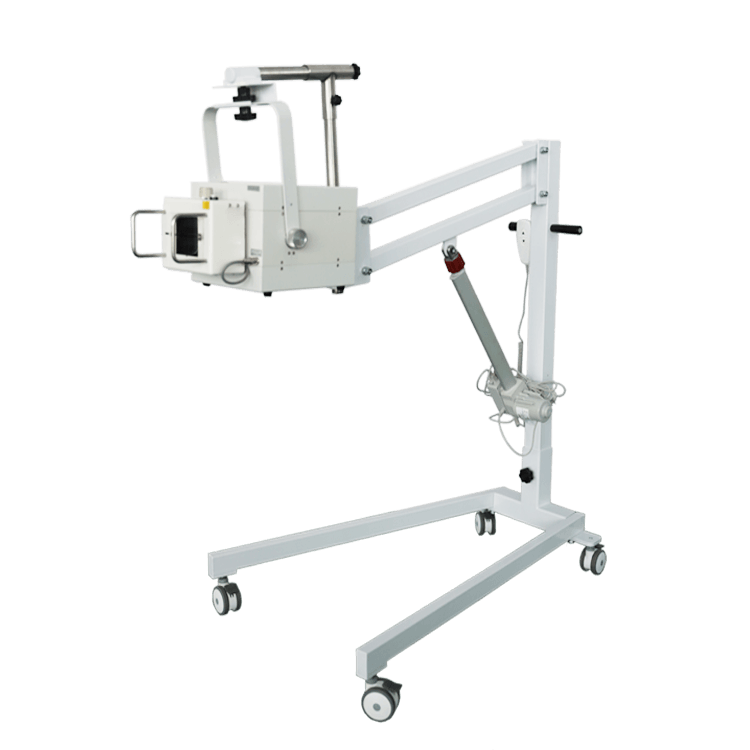
Mobile digital radiography has become routine in ICUs, emergency departments, operating rooms, and community screening programs. In these environments, the portable X-ray stand is not an accessory — it determines how quickly a technologist can position a detector, how stable image geometry remains during exposure, and whether one mobile X-ray stand can serve both bedside and upright examinations. This buyer’s guide to bedside DR imaging gives procurement teams and radiology buyers a specification-led framework for comparing systems on equal terms.
Start with the Clinical Scenario
Different workflows require different stand architectures. Identify the primary use case before comparing any mobile DR detector holder on price.
Bedside supine and oblique imaging — Choose a mobile flat-panel detector holder with a low centre of gravity, an arm that reaches under the bed, and a tiltable detector cradle. Cross-table and lateral views in bedside radiography depend on this reach.
Upright chest radiography and high-volume screening — A foldable upright stand is more efficient. Look for a detector centre height as low as approximately 70 cm above the floor, a travel range of at least 800 mm, and motorised or synchronous height adjustment with automatic detector alignment.
Supporting the X-ray source itself — If the stand carries the generator head, check for a folding frame, roughly 1,200 mm of column travel, a minimum source-to-floor distance of 300 mm or less, and ±180° head rotation.
Six Specifications to Verify in a Portable X-Ray Stand
1. Load capacity and clamp range. Calculate capacity from the actual detector weight, then add at least 20% headroom. A standard 14 × 17 in (43 × 35 cm) wireless panel needs a matched counterbalance. Telescopic arms on a mobile DR detector holder should accept 24.5–53.5 cm wide image receptors up to 30 mm thick, covering CR cassettes, DR panels, and long-length detectors.
2. Height travel and minimum working height. Bedside radiography requires the detector to sit close to — or slightly below — the mattress; upright work requires enough travel for a standing chest view. A stand with an impressive maximum height but a high minimum height will cut off anatomy in bedside projections.
3. Counterbalance and locking. Gas-spring or counterweighted systems allow hands-free positioning at any angle and remove repeated knob tightening. As an acceptance benchmark, load the arm at full extension and hold for 15 minutes; vertical drift should stay within 1 mm.
4. Base and castors. A weighted, low-centre base, 12.5 cm twin-wheel castors, and central or individual swivel locks are the foundation of safe movement in narrow wards. Castor guards help prevent cables from being run over — a small detail that matters in busy bedside DR imaging workflows.
5. Materials and weight. Aluminium alloy columns provide rigidity without excess mass; carbon-fibre tabletop panels reduce artefacts. For a lightweight portable X-ray stand, a self-weight of 15 kg or less and an X-ray source unit of 18 kg or less including battery make single-person transport and case packing realistic.
6. Connectivity and regulatory compliance. Confirm DICOM 3.0 and PACS compatibility.
Budget Priorities and Common Mistakes
When budgets are tight, follow the order: stand for safety, table for image quality, generator for consistency. Secure mechanical rigidity and dual locking first, then upgrade to a carbon-fibre tabletop. Motorised height adjustment and automatic alignment pay off once daily exam volumes exceed roughly 30 patients.
Frequent mistakes when selecting a bedside DR imaging stand include judging a system by maximum load alone while ignoring minimum height, chasing motorised features at the expense of braking and centre of gravity, overlooking detector clamp dimensions and cable management, and failing to check regulatory clearance or service response in the destination market.
Acceptance Testing Checklist
Before signing off a portable X-ray stand purchase: hold a full-load counterbalance test and measure drift; expose at both height limits and inspect the image edges for geometric distortion; push the unit through a doorway and check the brakes; verify image consistency during consecutive exposures; and review the registration dossier, manuals, warranty, and on-site training record.
Frequently Asked Questions
Q: What load capacity do I need for a bedside DR stand?
A: For a mobile DR detector holder, use the detector’s actual weight plus at least 20%. A 14 × 17 in wireless panel typically falls in the 6–8 kg counterbalance range.
Q: Is motorised height adjustment always better than manual?
A: No. Manual gas-spring stands are lighter, cheaper to maintain, and well suited to low-frequency transport. High-throughput screening benefits more from motorised travel and automatic alignment.
Q: Must the generator, detector, and stand come from one brand?
A: Many public tenders require single-brand systems for interoperability and service simplicity. In independent configurations, the decisive factors are documented protocol compatibility and clearly assigned after-sales responsibility.
Q: Can one stand handle both bedside and upright imaging?
A: Yes, if it folds for transport, offers four-way detector adjustment with hands-free positioning, and provides column travel that covers a standing chest view.