If you are sourcing an X-ray detector for a hospital, veterinary clinic, dental practice, or industrial inspection line, you have probably noticed one phrase appearing again and again in product pages: low dose X-ray flat panel detector. Every manufacturer claims dose reduction, but few explain how it is achieved or how to verify it. This guide answers the questions international buyers actually ask before placing an order.
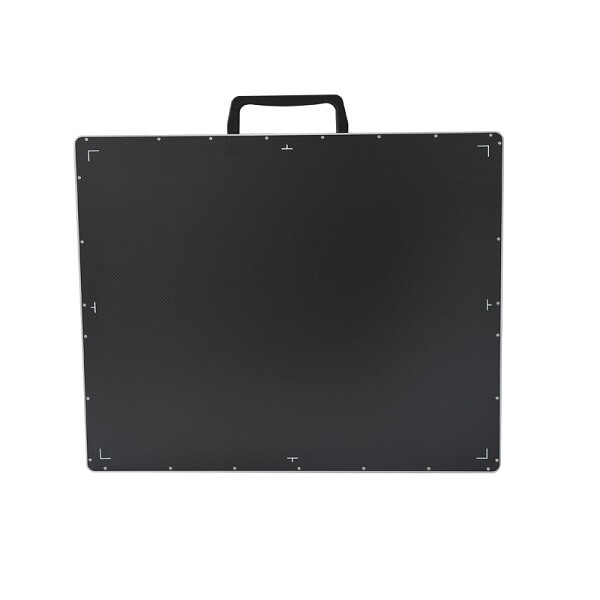 What Is a Low Dose X-Ray Flat Panel Detector?
A low dose X-ray flat panel detector (FPD) is a digital X-ray imaging sensor engineered to produce diagnostic-quality images while significantly reducing the radiation dose delivered to the patient or operator. Instead of using film or a computed radiography (CR) cassette, the detector converts X-ray photons into an electrical signal directly or through a scintillator layer, then sends the digital image to a workstation in seconds.
The “low dose” label does not refer to a single component. It is the combined result of sensor efficiency, scintillator material, readout electronics, and image processing software working together so that fewer X-ray photons are needed to form a usable image.
How Does a Flat Panel Detector Reduce Radiation Dose?
Dose reduction is achieved through four main engineering routes:
1. High Detective Quantum Efficiency (DQE)
DQE measures how efficiently a detector converts incoming X-ray photons into image signal. A detector with DQE above 70% at low frequencies captures more information from every photon, so the generator can operate at a lower mAs. In practical terms, a high-DQE detector can reduce patient dose by 30% to 50% compared with CR systems, and even more compared with conventional film.
2. Cesium Iodide (CsI) Scintillator
Most low dose detectors use a structured (columnar) CsI:Tl scintillator grown like microscopic needles on the photodiode surface. Light travels down these columns instead of scattering sideways, which preserves sharpness and allows a thinner scintillator layer — meaning less X-ray is needed. Amorphous silicon (a-Si) detectors paired with CsI are currently the industry standard for low dose radiography.
3. Low-Noise Readout Electronics
Noise matters more at low dose, because fewer photons means a weaker signal. Modern detectors use low-noise ASICs and dual- or multi-gain readout modes that keep the image clean even when exposure drops. When comparing suppliers, ask for the noise floor value in DN (digital numbers), not just the pixel pitch.
4. Intelligent Image Processing
Software-based noise reduction, dynamic range optimization, and automatic exposure recognition let the detector deliver a diagnostic image at reduced mAs without visible quality loss. Note that processing cannot compensate for a poor sensor — it only enhances an already efficient one.
Key Specifications to Compare Before Buying
| Specification | Typical range | Why it matters |
| Active area | 35×43 cm, 43×43 cm, 30×30 cm, 25×30 cm | Must match your clinical workflow and generator field |
| Pixel pitch | 100–139 µm | Smaller pitch = higher resolution; 139 µm is standard for general radiography |
| DQE(0) | ≥ 65–75% | The single best indicator of low dose capability |
| A/D bit depth | 14–16 bit | Determines dynamic range and gray-level detail |
| Spatial resolution | ≥ 3.5–4.0 lp/mm | Sharpness for fine structures like bone trabeculae |
| Frame rate | 1–30 fps | Matters for dynamic studies and C-arm use |
| Dose at standard exam | ~2–8 µGy detector dose | Lower detector dose with acceptable SNR = genuine low dose design |
Common Applications
– General radiography (DR rooms): chest, skeletal, and abdominal imaging where patient dose and retake rate are the main quality metrics.
– Veterinary X-ray systems: animals cannot be positioned repeatedly, so a first-shot, low dose detector directly reduces retakes and sedation time.
– Dental and maxillofacial imaging: panoramic and CBCT detectors benefit from CsI-based low dose design.
– Mobile and surgical C-arms: pulsed fluoroscopy with high frame-rate FPDs minimizes dose to patient and surgeon alike.
– Industrial NDT: electronics inspection, weld testing, and battery inspection use the same low dose principle to protect samples and operators.
Practical Questions Buyers Ask
How much dose reduction can I actually expect?
With a CsI + a-Si flat panel detector at DQE ≥ 70%, most facilities report a 30–50% exposure reduction versus CR, and retake rates falling below 3% because images are available in seconds and can be repeated immediately.
Is low dose the same as low image quality?
No. Dose and quality are governed by the same physics (quantum noise). A truly low dose detector achieves its result through higher efficiency, not by suppressing information. Always request a modulation transfer function (MTF) and DQE curve along with the dose specification.
Which is better: 100 µm or 139 µm pixel pitch?
For general radiography, 139 µm is fully sufficient and offers a better price-performance ratio. Choose 100 µm for orthopedic detail work, dental, or veterinary dental applications where fine bone texture matters.
Does the detector need an external chiller or special power?
Most modern FPDs are air-cooled, low-power devices (typically under 30 W) connecting via Gigabit Ethernet or fiber. Confirm the interface matches your existing workstation before ordering.
How to Choose a Low Dose Detector Supplier
1. Ask for measured data, not marketing numbers. Request DQE/MTF test reports, ideally from a third-party lab or per IEC 62220-1.
2. Verify calibration and service support abroad. A detector is a 7–10 year investment. Ask about gain calibration tools, spare-part availability, and remote diagnostics.
3. Check software compatibility. The detector must integrate with your acquisition workstation, PACS, and DICOM workflow. Request a demo of the full chain, not just the sensor.
4. Compare warranty terms. Leading suppliers offer 2–3 years on the panel itself, with clear policies on scintillator degradation.
5. Order a sample image set at clinical dose. The fastest way to judge a “low dose” claim is to see chest and hand phantom images acquired at 2–4 µGy.
Conclusion
A low dose X-ray flat panel detector is not a special product category — it is the current standard for digital radiography, defined by high DQE, a structured CsI scintillator, low-noise electronics, and smart processing. For buyers, the practical checklist is short: verify DQE data, match the active area and interface to your system, confirm certifications, and test real images at clinical dose. Suppliers who can produce this evidence within 48 hours are the ones worth shortlisting.
Author: X Ray Machine Accessories
E-mail: newheekcn@163.com
Tel: +86 19015366638
Whatsapp:+86 19015366638
Company: Weifang Newheek Electronic Technology Co., Ltd.
ADD: E Building of Future Star Scientific Innovation Industrial Zone of No.957 Wolong East Street, Yulong Community, Xincheng Sub-District Office, Weifang Hi-tech Zone, Shandong Province, China