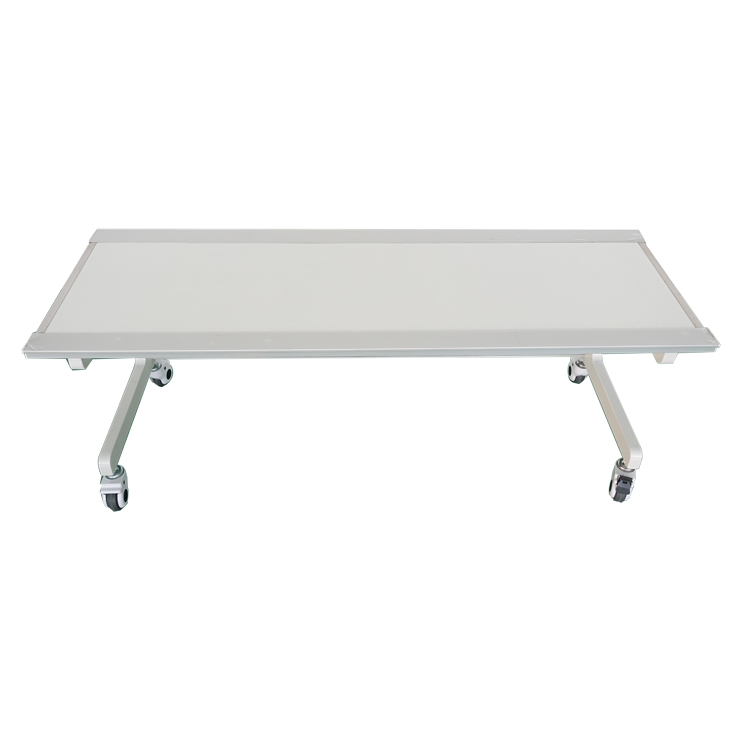
When a clinic budgets for a new X-ray room, the table rarely gets the attention it deserves. Yet the choice between a movable flat table and a fixed radiography table directly affects patient throughput, room flexibility, installation cost and long-term return on investment (ROI). If you are currently searching for a movable X-ray table for sale or weighing options for a portable radiography table clinic setup, this guide walks you through the trade-offs — and shows where a model like the Newheek NKPIIIAY movable flat table fits in.
Quick Answer: Which Table Should You Choose?
Choose a movable flat table if your space is limited, you share rooms between modalities, or you run mobile and multi-site screening services.
Choose a fixed radiography table if you are a high-volume department performing a large number of daily studies that all follow the same workflow.
Unsure? Many clinics start with a movable flat table and add a fixed table later as case volume grows — the movable unit is never wasted, because it can be redeployed to a second room or an outreach program.
What Is a Movable Flat Table?
A movable flat table is a radiographic table mounted on lockable casters, with a flat, low-profile tabletop that accepts a patient in supine, lateral and oblique positions while the X-ray tube and detector do the work. Because the table is not bolted to the floor or tied to a floor-mounted tube stand, it can be repositioned within the room — or moved to another room entirely.
The NKPIIIAY movable flat table from Newheek is a typical example of this category. It is designed as a companion table for mobile and fixed X-ray machines, with a reinforced flat top, smooth-rolling casters with brakes, and an easy-to-disinfect surface. It is commonly used in:
Small and mid-size clinics with one shared X-ray room
Orthopedic and sports medicine practices
Veterinary radiography
Mobile screening units and temporary examination sites
Second rooms or overflow capacity in growing hospitals
What Is a Fixed Radiography Table?
A fixed radiography table is permanently installed in the X-ray room, usually paired with a floor- or ceiling-mounted tube stand, a Bucky tray, and in many cases a floating tabletop that tracks with the tube. This arrangement is optimized for speed and repeatability: the operator positions the patient once, and the tube/column does the fine positioning electronically.
Fixed tables shine in environments where the same workflows repeat hundreds of times a day — general radiology departments, emergency imaging, and hospitals with dedicated radiographic rooms.
Side-by-Side Comparison
| Factor | Movable Flat Table (e.g., NKPIIIAY) | Fixed Radiography Table |
|---|---|---|
| Installation | No floor anchoring; ready to use after positioning | Requires floor preparation, anchoring and tube-stand alignment |
| Room flexibility | Can be moved between rooms or off-site | Locked to one dedicated room |
| Initial cost | Lower; no integration work | Higher; includes installation and commissioning |
| Workflow speed | Manual repositioning of the table | Floating tabletop + tube tracking for fast repeats |
| Space needed | Compact footprint; wheeled access path required | Larger dedicated room with clear tube travel |
| Best fit | Clinics, mobile services, multi-purpose rooms | High-volume hospital radiology departments |
Constrained Clinics vs. High-Volume Departments
1 — Space-Limited Clinic
For a clinic where every square meter earns revenue, the movable flat table wins on three fronts:
Lower entry cost. No anchoring, no tube-stand integration, no room renovation. The table arrives, rolls into place, and the room is live.
One room, multiple uses. Between X-ray sessions the table can be parked against a wall and the space used for ultrasound, physiotherapy or consultations. A fixed table would permanently occupy that footprint.
Asset mobility. If the clinic relocates or opens a second branch, the table goes with it. That is residual value a bolted-down table simply does not have.
In ROI terms, a space-constrained clinic typically reaches payback faster with a movable flat table because the investment is smaller, installation downtime is near zero, and the same room keeps generating revenue for other services.
2 — High-Volume Department
In a department performing well over a hundred table studies per day, seconds per case compound into hours. Here the fixed radiography table justifies itself:
Faster patient throughput. Floating tabletops and motorized tube tracking reduce repositioning time on every single exposure.
Less operator strain. Staff never push a loaded table between cases — an ergonomic and safety benefit over long shifts.
Integrated workflow. Bucky trays, automatic exposure tracking and grid alignment are all pre-engineered, reducing repeat exposures caused by setup variation.
The higher purchase price is offset by labor efficiency: when each study saves one to two minutes, a busy room recovers staff hours every week — usually enough to close the cost gap within the first year or two of operation.
Most real facilities are not purely one or the other. A common and cost-effective configuration is a fixed room for routine volume plus one NKPIIIAY movable flat table that serves as backup, overflow capacity, pediatric/limited-mobility positioning aid, and off-site screening asset. This hybrid layout captures the ROI strengths of both categories.
Load Capacity: What to Check Before You Buy
Whatever category you choose, load capacity deserves a hard look — especially for a portable radiography table for clinic use, where patients may include bariatric cases and the table may be moved while loaded:
Rated patient load. Confirm the table’s maximum load with margin above your heaviest expected patients, not just your average case.
Frame construction. The NKPIIIAY uses a reinforced welded steel frame designed to stay rigid under full working load — flex or wobble at the tabletop leads to motion blur and repeat exposures.
Caster rating and brakes. On a movable table, casters are a load-bearing component. All casters should lock, and brakes should hold firm on typical clinic flooring.
Transfer loads. Patients sit, shift and sometimes need assistance sliding onto the table. Edge reinforcement and a non-slip mattress matter as much as the center-load rating.
For the exact rated load and dimensional drawings of the NKPIIIAY, request the specification sheet from Newheek.
Cleaning and Maintenance Notes for a Movable Flat Table
A movable table lives a harder life than a fixed one — it touches more rooms, more floors and more hands. A simple routine keeps it hygienic and extends its service life:
Daily
Wipe the tabletop and mattress with a neutral hospital-grade disinfectant after each patient or each shift.
Check for and immediately clean up blood, contrast agent or gel spills — dried contaminants degrade both the coating and the mattress cover.
Weekly
Clean caster wheels and remove hair, dust and debris wrapped around axles.
Test every caster brake under a light load to confirm it holds.
Inspect the mattress cover for cracks or peeling — a compromised cover traps fluid and becomes an infection risk.
Monthly / Quarterly
Tighten frame fasteners and check the flat top for level.
Inspect welds and coatings for chips or corrosion, touching up as needed.
Grease moving parts per the manufacturer’s manual; use only approved lubricants.
What to Avoid
Corrosive or chlorine-rich cleaners on painted and coated surfaces.
High-pressure water jets — they force moisture into casters and frame joints.
Rolling the loaded table over thresholds or cables at speed; use ramps and keep transfer paths clear.
Frequently Asked Questions
What is the load capacity of the NKPIIIAY movable flat table?
The NKPIIIAY is built on a reinforced steel frame designed for routine radiographic workloads, including heavier patients. For the exact rated load of your configuration, contact Newheek for the detailed specification sheet.
Can a movable flat table replace a fixed radiography table?
For low-to-medium volume clinics, mobile services and screening programs — yes, in most cases. A movable flat table like the NKPIIIAY covers the standard supine and lateral table work that dominates general radiography. High-throughput departments running hundreds of daily studies will still get better per-case speed from a fixed table with tube tracking.
Does a movable table need special flooring?
No anchoring is required, but the floor should be level and hard enough for casters to roll and brake reliably. Very soft or uneven flooring will make positioning harder and accelerate caster wear.
How long does delivery and setup take?
A movable flat table requires no installation work — positioning and a function check are enough, so the room can typically go live the same day the table arrives.
Ready to Choose Your Table?
If your priority is flexibility, fast deployment and multi-room value, the NKPIIIAY movable flat table is a proven, clinic-friendly choice — and one of the most practical movable X-ray tables for sale on the market today. If your department is built for high daily volume, a fixed radiography table remains the throughput champion.
Contact Newheek for the NKPIIIAY specification sheet, load ratings, and a quotation matched to your clinic’s workflow. Our engineers will help you size the table, confirm caster and load requirements, and plan delivery.
Author: X Ray Machine Accessories
E-mail: newheekcn@163.com
Tel: +86 19015366638
Whatsapp:+86 19015366638
Company: Weifang Newheek Electronic Technology Co., Ltd.
ADD: E Building of Future Star Scientific Innovation Industrial Zone of No.957 Wolong East Street, Yulong Community, Xincheng Sub-District Office, Weifang Hi-tech Zone, Shandong Province, China