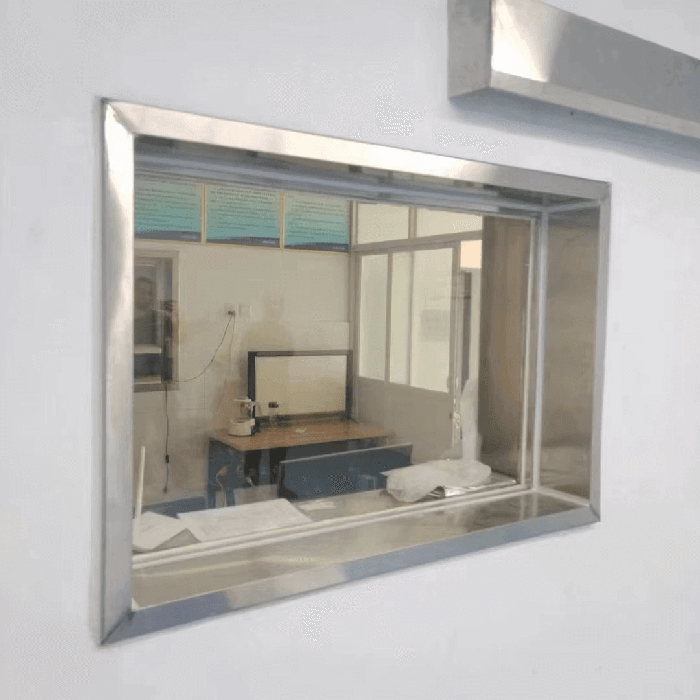
Lead glass, also known as radiation shielding lead glass, is a special high-density glass doped with lead oxide or barium compounds, designed to attenuate X-ray and low-energy gamma radiation while maintaining transparent visibility. It is the core material for viewing windows in radiology rooms, dental X-ray suites, fluoroscopy labs, industrial NDT stations and security inspection cabins. Unlike ordinary float glass, its primary function is radiation attenuation, not just light transmission. For hospital builders, radiology engineers, medical equipment distributors and radiation protection contractors, understanding lead equivalent and selection rules is critical to meet regulatory compliance, operator safety and project budget control.
What is Lead Equivalent (mmPb)?
Lead equivalent (marked as mmPb, lead equivalence) is the most important specification of X-ray lead glass. It means the glass delivers the same radiation shielding effect as a pure lead sheet of the stated thickness, tested under defined kVp, filtration and exposure conditions.
A common misunderstanding among buyers: glass physical thickness ≠ lead equivalent. For example, 12 mm thick lead glass does not automatically equal 12 mmPb. The actual mmPb rating depends on raw material formula, lead oxide content and test energy. One 12 mm panel may reach 2.0 mmPb at 100 kVp, while another formula only reaches 1.5 mmPb. Always check the test certificate with clear kVp parameters instead of judging shielding capacity only by glass thickness.
Typical commercial lead glass lead equivalent ranges cover 0.5 mmPb, 1.0 mmPb, 1.5 mmPb, 2.0 mmPb, 2.5 mmPb and 3.0 mmPb. Higher mmPb provides stronger radiation blocking, yet it brings higher density, heavier weight, darker tint and higher material cost.
Common Applications of X-Ray Lead Glass
1. General radiography rooms: Operator observation windows beside fixed DR and X-ray machines, normally 1.5–2.0 mmPb
2. Dental X-ray & panoramic CBCT rooms: Small viewing windows, usually 0.5–1.0 mmPb
3. Fluoroscopy, angiography and interventional suites: Continuous high scattered radiation, 2.0–3.0 mmPb is widely specified
4. Industrial non-destructive testing (NDT): X-ray flaw detection booths for casting and welding inspection
5. Airport, customs security scanners & nuclear research laboratories
Clear visual observation is non-negotiable in these scenes. Lead glass lets operators watch patients or samples directly without opening the shielding barrier, avoiding unnecessary radiation exposure.
Step-by-Step Selection Guide for Lead Glass
1. Confirm required lead equivalent first
The safest reference is the shielding calculation report from a qualified medical radiation physicist or project architect, based on machine kVp, weekly workload, distance from X-ray tube, adjacent room occupancy and local radiation protection codes.
Dental X-ray: 0.5–1.0 mmPb
General DR / X-ray room (80–125 kVp): 1.5–2.0 mmPb (most popular specification)
Fluoroscopy, cath lab, high workload radiology: 2.0–3.0 mmPb
Do not over-specify blindly. Extra high mmPb raises window frame load and installation difficulty, while under-specification will fail inspection and endanger staff.
2. Check optical quality
Good shielding lead glass features high light transmittance, low yellow tint, minimal bubble, stripe and internal impurity. Severe yellowing or distortion affects real-time patient monitoring. For long-term hospital use, anti-oxidation surface treatment is recommended to slow colour darkening over years.
3. Consider window size, weight and frame matching
Lead glass is far heavier than regular glass. Larger custom panels require reinforced lead-lined steel frames. A critical detail many buyers ignore: the frame must have equal or higher lead equivalent than the glass. If the glass is 2 mmPb but the surrounding frame only reaches 1 mmPb, radiation leakage will occur at the gap and the whole shielding window fails compliance check.
4. Verify certification and test reports
Reliable suppliers provide official radiation attenuation test certificates, stating test voltage, filtration, glass size and guaranteed mmPb. For international hospital and tender projects, documents matching IEC or local national radiation standards are required. Avoid uncertified low-price lead glass with unstable shielding performance.
5. Installation & maintenance notes
Lead glass is fragile and sensitive to impact. Edges should be protected during cutting, delivery and mounting. Seal gaps between glass and frame with lead rubber strips to eliminate radiation leakage points. Clean only with neutral soft detergent; abrasive cleaners will scratch the surface and accelerate ageing.
Frequently Asked Questions
Q: Does higher kVp always need higher mmPb lead glass?
A: Yes, within diagnostic X-ray range. Higher energy X-rays are more penetrating, so the physicist will upgrade lead equivalent accordingly.
Q: Can I use ordinary laminated glass instead of lead glass for X-ray rooms?
A: No. Normal glass has almost no X-ray attenuation ability and cannot meet radiation safety requirements.
Q: Can lead glass be custom cut to special sizes?
A: Yes. Most manufacturers support custom cutting, drilling and edge polishing for non-standard window openings.
Final Tips for Your Purchase
When sending an inquiry to suppliers, prepare these details to get accurate quotation: required mmPb rating, working kVp, finished window dimension, quantity, frame requirement, certification standard and delivery destination.
Selecting proper X-ray shielding lead glass balances safety, visibility, compliance and cost. Our lead glass series offers stable lead equivalent, clear optics, full test documentation and custom processing for medical radiology, dental, industrial NDT and security projects. Contact us today to get technical datasheets and tailored solutions for your radiation shielding window project.
Author: X Ray Machine Accessories
E-mail: newheekcn@163.com
Tel: +86 19015366638
Whatsapp:+86 19015366638
Company: Weifang Newheek Electronic Technology Co., Ltd.
ADD: E Building of Future Star Scientific Innovation Industrial Zone of No.957 Wolong East Street, Yulong Community, Xincheng Sub-District Office, Weifang Hi-tech Zone, Shandong Province, China