Walk into any X-ray showroom and the first question you will be asked is: “100 mA, 300 mA, or 500 mA?”
It is the right question, badly framed. The milliampere figure is not a quality rating and it is not a feature. It is a power class — a shorthand for how much generator you are buying, how much electrical infrastructure your building needs, and how fast your staff can work through a list.
This guide explains what each class actually buys you, where each one stops being enough, and how the three map onto the machines we build — so you can pick the tier that fits your caseload instead of the one that fits a brochure.
The number on the brochure is not the number that decides image quality
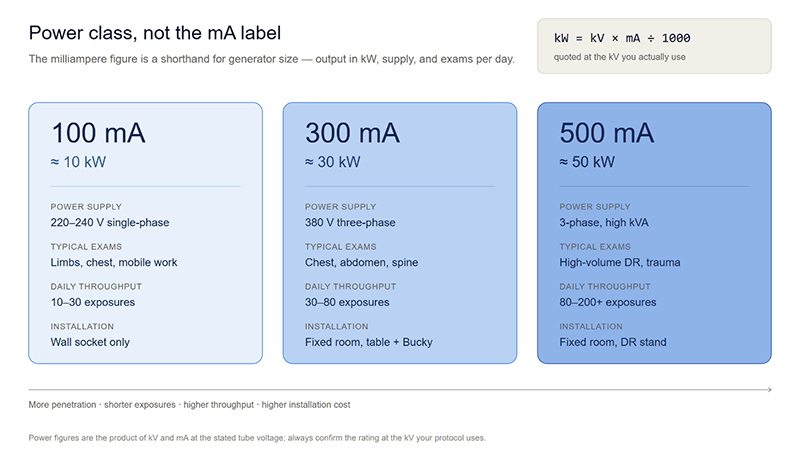
X-ray output power is the product of tube voltage and tube current:
Power (kW) = kV × mA ÷ 1000
Because mA is always quoted at a given kV, the headline figure hides the real number:
| Headline | Real meaning | Generator class |
| 100 mA | 100 mA at 100 kV = 10 kW | 5–10 kW |
| 300 mA | 300 mA at 100 kV = 30 kW | 20–32 kW |
| 500 mA | 500 mA at 100 kV = 50 kW | 40–50 kW |
A “100 mA” machine and a 500 mA” machine do not produce different sharpness. Sharpness comes from focal spot size and the detector. Contrast comes from kV selection and image processing. What the power class changes is how much radiation you can deliver in how short a time, at what penetration, for how many patients per hour.
That is a workflow and physics question — and it has a hard ceiling that shows up as blur, repeats, and rejected large patients.
What a higher mA class really buys you
1. Shorter exposures = fewer motion artefacts. A 100 mA unit at 70 kV needs roughly 0.1 s for a lateral thorax on a 20 kg patient; the same exposure on a 500 mA unit is a fraction of that. For paediatric, veterinary, or any patient that will not hold still, this is the single most valuable thing money can buy.
2. Penetration headroom. Large patients need high kV and enough mA to keep the exposure time practical. At 120 kV a 100 mA unit is delivering 12 kW — fine for a limb, marginal for a thick abdomen. At 500 mA the same kV gives you 60 kW of headroom, which is what makes a lateral lumbar spine on a 100 kg patient a one-shot exam.
3. Duty cycle. Throughput is limited by anode heat, not by the brochure mA. A busy clinic doing 60 exposures a day will feel the difference between a stationary anode head with a small heat capacity and a rotating-anode, oil-cooled assembly.
4. Technique range. Wider mA and mAs ranges mean your technologists stop improvising. If the machine cannot express the technique the protocol calls for, they will compensate with distance and time — and consistency goes out the window.
What it does not buy: resolution, contrast, dose efficiency, or a better image on a thin wrist. Do not pay for 500 mA to photograph fingers.
The three classes at a glance
| 100 mA class | 300 mA class | 500 mA class | |
| Typical power | 5–10 kW | 20–32 kW | 40–50 kW |
| kV range | 40–125 kV | 40–125 kV | 40–150 kV |
| mA range | 10–100 mA | 16–300 mA | 10–630 mA |
| Power supply | Single-phase 220–240 V | Three-phase, dedicated circuit | Three-phase, high kVA |
| Form factor | Portable / mobile | Floor-mounted table + Bucky | Table + upright Bucky / DR stand |
| Typical exams | Limbs, extremities, chest (small patients), field & mobile work | Chest, abdomen, spine, pelvis; general practice | High-volume DR, large patients, full-body, trauma, fluoro-capable |
| Throughput | 10–30 exposures/day | 30–80 exposures/day | 80–200+ exposures/day |
| Best fit | Small clinic, vet, mobile service, satellite room | Single-room clinic or small hospital | Busy imaging centre, hospital department, high-volume DR |
100 mA: portable power, portable constraints
The 100 mA class is the entry point, and modern high-frequency designs have made it far more capable than the label suggests. Our NKY100 is the reference build in this tier.
| Parameter | NKY100 |
| Nominal output power | 5 kW (5.3 kW max) |
| Tube voltage | 40–125 kV, 1 kV steps |
| Tube current | 10–100 mA |
| mAs range | 0.1–200 mAs |
| Focal spots | 0.6 / 1.8 mm (small / large) |
| Target angle | 15° |
| Total filtration | ≥ 2.5 mm Al equivalent |
| Supply | 220–240 VAC single phase |
| Head weight | ~15 kg |
| Detector pairing | NK4343S wired / NK4343W wireless, 430 × 430 mm |
Choose it if: you run a small clinic, a veterinary practice, a satellite or outreach room, or a mobile service where the machine has to be carried and plugged into a wall socket that already exists. It covers extremities, chest, and small-to-medium body parts well, and the 0.1–200 mAs range is generous for its class.
Skip it if: more than a handful of your patients are over ~80 kg, you need a lateral lumbar spine or a full abdomen routinely, or you are planning a fixed room with a Bucky table. You will spend the next three years working around the machine instead of with it.
Practical note: the single-phase supply is the hidden advantage. No three-phase upgrade, no new distribution board, no electrician quote that costs more than the machine. For a clinic that is renting its space, that alone can decide the purchase.
300 mA: the general-practice workhorse
The 300 mA class is where a room stops being “an X-ray machine in a corner” and becomes a radiography room: a floor-mounted table with a Bucky, a tube column that travels the length of the table, and enough generator to shoot anything a general practice sees.
Our TR300 is the 300 mA diagnostic unit in this tier — 40–125 kV, up to 300 mA, with a 2000 × 800 mm table, a column that travels ≥ 1100 mm along the table, 610 mm of vertical travel, and a cassette tray that takes up to 356 × 432 mm (14″ × 17″).
For buyers who need a fixed room but do not need 300 mA yet, the TR20G sits directly beneath it and is the honest entry point: 20 kW (100 kV × 200 mA), 40–125 kV, 16–200 mA in 12 steps, 0.5–320 mAs, 1.0 / 2.0 mm focal spots, table and Bucky included, 380 V ± 38 V three-phase five-wire, 25 kVA input.
Choose it if: you are equipping one room for general radiography — chest, abdomen, spine, pelvis, extremities — with a technologist on site and a patient mix that includes adults of average build. This is the tier where a fixed installation finally pays for itself in throughput and consistency.
Skip it if: you are a single-vet practice doing mostly limbs and thorax (buy the 100 mA and put the savings into a better flat panel), or you are projecting 80+ patients a day within two years (go straight to 500 mA — upgrading a room twice costs more than buying it once).
The real decision here is electrical, not radiological. Three-phase 380/400 V, a dedicated circuit, an earth under 0.5 Ω, and a room that meets your local shielding rules. Budget for that before you compare unit prices; on many projects the electrical work is the larger line item.
500 mA: throughput, penetration, and DR at full speed
At 500 mA you are no longer buying an X-ray machine. You are buying a DR system: a 40–50 kW high-frequency generator, a double-column or ceiling-suspended stand, a flat panel, and a workflow that assumes the patient is already positioned when the exposure happens.
Our configuration in this tier pairs the NKG-40R (40 kW) or NKG-50R (50 kW) high-frequency generator with the NKX500 double-column DR stand and a 430 × 430 mm flat panel. Where the room has to move instead of the patient, the vehicle-mounted DR platform runs a 500 mA nominal tube (10–630 mA range, 150 kV at 320 mA) — the same power class, different chassis.
Choose it if: you are running 80+ exposures a day, imaging large or uncooperative patients, doing trauma or theatre work, or you need fluoroscopy-capable headroom. At this tier the limiting factor stops being the generator and becomes your workflow — which is the point: the machine should never be the reason a patient waits.
Skip it if: your caseload is under ~50 exposures a day and your patients are mostly under 80 kg. You will pay for kVA you never use and inherit a room you cannot move.
Side-by-side: the three tiers as we build them
| NKY100 (100 mA) | TR20G / TR300 (300 mA class) | NKG-40R/50R + NKX500 (500 mA class) | |
| Output power | 5 kW (5.3 kW max) | 20 kW / 30 kW | 40 kW / 50 kW |
| kV | 40–125 kV | 40–125 kV | 40–150 kV |
| mA | 10–100 mA | 16–200 mA (TR20G) / up to 300 mA (TR300) | 10–630 mA |
| mAs | 0.1–200 mAs | 0.5–320 mAs | — |
| Focal spot | 0.6 / 1.8 mm | 1.0 / 2.0 mm | per tube assembly selected |
| Supply | 220–240 VAC, 1-phase | 380 V ± 38 V, 3-phase, 25 kVA | 3-phase, sized to generator kVA |
| Install | Wall socket | Fixed room, table + Bucky | Fixed room, DR stand + panel |
| Mobility | Portable, ~15 kg head | None | None (or vehicle-mounted) |
| Typical throughput | 10–30 / day | 30–80 / day | 80–200+ / day |
The decision in five questions
1. How heavy are your patients? If more than ~20% are over 80 kg, the 100 mA tier will produce repeats on abdomen and spine. Move up.
2. How many exposures a day, at peak? Multiply your busiest day by 1.5. Buy for that number, not for today’s average.
3. Can the room take three-phase power? If not — and cannot be upgraded economically — the 100 mA class is your ceiling, and a better detector is your best remaining upgrade.
4. Who is exposing? A trained technologist with a protocol list extracts far more from a 300 mA room than an untrained operator does from a 500 mA one. Power amplifies skill; it does not replace it.
5. What does year three look like? If you expect to double volume or add a second room, buy the tier above what you need today. Rebuilding a room twice is the most expensive mistake in this category.
Five mistakes buyers make
Buying mA and forgetting kW. A 300 mA head on a 20 kW generator cannot deliver 300 mA at 120 kV. Always check the power rating at the kV you actually use.
Budgeting for the machine and not the room. Three-phase supply, earthing, shielding, and the table are part of the price of the 300 mA and 500 mA tiers.
Pairing a good generator with a weak detector. Once you pass ~20 kW, the flat panel becomes the limiting factor in image quality. Do not spend the budget upside down.
Ignoring duty cycle. A machine rated for intermittent operation will thermal-limit in a busy list. Ask for the anode heat capacity and the maximum continuous dissipation, not just the peak mA.
Skipping the acceptance test. kV accuracy, mA accuracy, mAs accuracy, and leakage are all specified — verify them on installation, not after the first complaint.
FAQ
Is a 500 mA machine always better than a 300 mA machine?
No. Above the point where your caseload and patient size are satisfied, extra power buys nothing you can see on the image. A well-set-up 300 mA room with a good panel beats an under-used 500 mA room with a mediocre one.
Can I start with 100 mA and upgrade later?
You can, and many clinics do — but “upgrade” usually means a new room, not a new part. If you are confident about growth, buy the room once.
What supply does a 100 mA portable need?
A standard single-phase 220–240 V circuit. That is the main reason this tier dominates mobile and satellite work — it installs anywhere.
Do I need a rotating anode?
For anything above occasional extremity work, yes. Heat capacity, not mA, sets your real daily limit.
Does a higher mA class mean more dose to the patient?
Not inherently. Higher output lets you shorten exposure time, which reduces motion dose-waste. Dose is governed by kV, filtration, collimation, and technique — which is why every unit we ship includes beam limitation and ≥ 2.5 mm Al equivalent filtration.
Tell us three things — patient mix, peak daily exposures, and whether the room has three-phase power — and we will tell you which tier you actually need, with the configuration and the electrical requirements in writing. If the honest answer is “the smaller machine”, we will say so.
[Request a configuration review →]
Author: X Ray Machine Accessories
E-mail: newheekcn@163.com
Tel: +86 19015366638
Whatsapp:+86 19015366638
Company: Weifang Newheek Electronic Technology Co., Ltd.
ADD: E Building of Future Star Scientific Innovation Industrial Zone of No.957 Wolong East Street, Yulong Community, Xincheng Sub-District Office, Weifang Hi-tech Zone, Shandong Province, China